
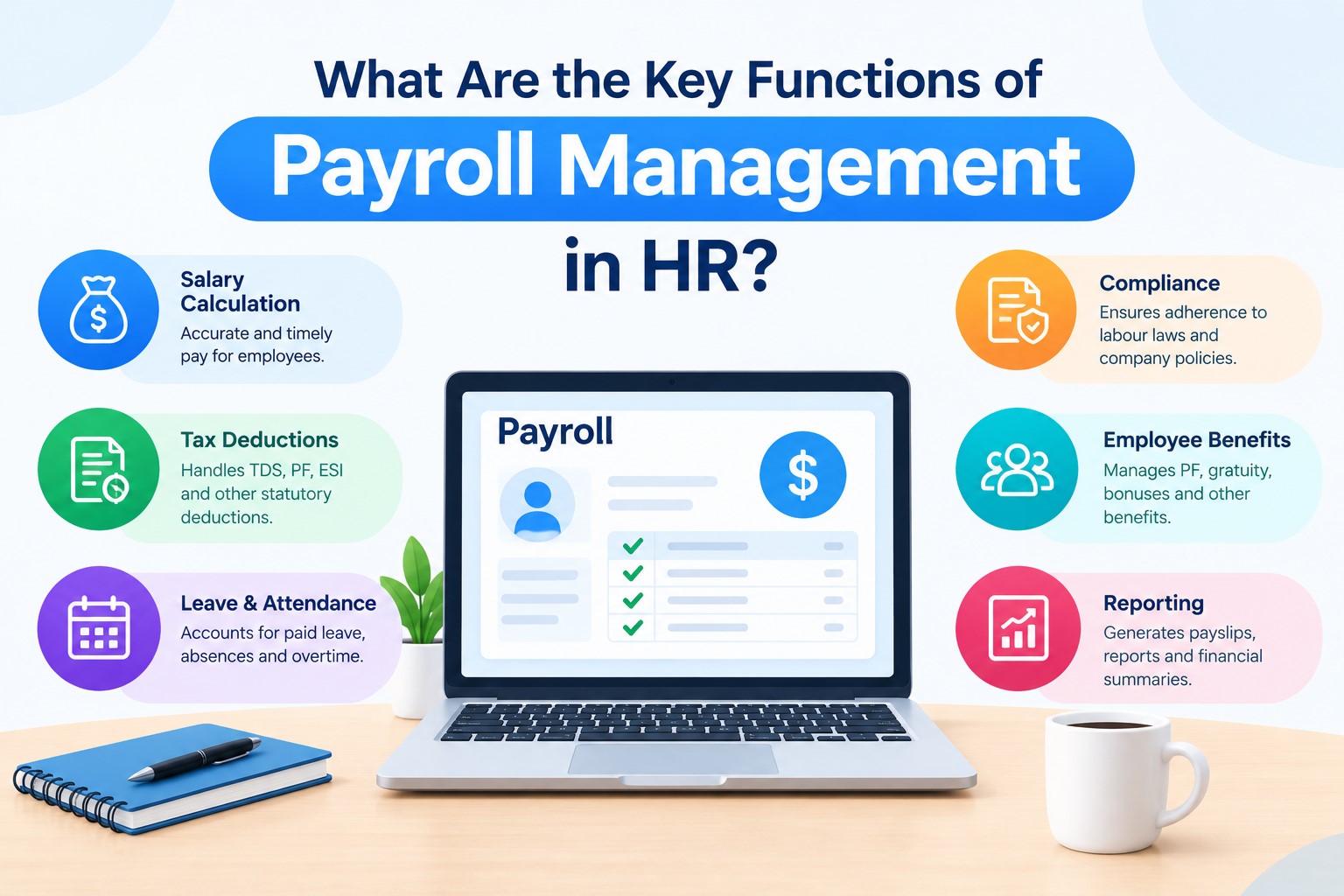
Payroll management is among the most crucial activities in the management of human resources. Every organisation requires a good payroll management system that will help in the calculation of salaries, deduction of taxes, keeping attendance details, and making timely payments. Sometimes, even minor mistakes in payroll management may cause problems for employees, compliance problems, and more administrative work. Good payroll management assists organisations in maintaining accuracy in accounting while fostering employee-employer relationships at the same time. Contemporary payroll management is not simply concerned with the calculation of salaries per month. Payroll management is the integration of employee details, attendance details, salary, taxation, compliance, and accounting.
Salary Calculation and Processing
The first task performed in payroll management is the calculation of salary for the employees. The payroll staff takes into account the basic salary, allowances, bonuses, overtime pay, incentives, and any other income for determining the total compensation of an employee. In addition, the deductions like income tax, contributions to the provident fund, and any other deductions are calculated by the payroll staff. The final amount that is paid to an employee is referred to as net salary. An employee can have a fixed monthly salary along with incentives and a travel allowance. To further know about it, one can visit the HR Payroll Course. The payroll staff will add all the permissible income, make the deductions, and process the payroll as per the company’s payroll schedule.
Attendance and Leave Management
Attendance tracking has a direct impact on payroll calculations, especially when a company compensates its employees based on the number of working hours or shifts. Information from attendance tracking can be used to calculate payable days, overtime, unpaid leave days, among others. Human resource departments can gather information about attendance by using biometric attendance systems, attendance applications, timesheets, or even HR management software. It is equally necessary to track leaves because paid leaves, unpaid leaves, or other types of leaves could have various impacts on payroll processing. For example, when an employee uses unpaid leave within a salary period, there will be a need to calculate the payable salary depending on the company’s policy.
Tax Calculation and Statutory Compliance
Organisations need to be aware of the relevant laws on employment, taxes, and social security while performing their payroll operations. In the case of India, some of the obligations of organisations for their employees can include the deduction of tax at source, contribution towards provident fund, employee state insurance if applicable, professional tax if applicable, and other similar obligations. It is important for payroll personnel to know about the legal framework that is relevant for the organization and the employees. Payroll personnel have to maintain correct records, create the necessary statements, and make sure that all payments and filings are done before the relevant deadline period. Some tax calculations may be based on salary structure, declarations made by employees, deductions made to income, and the tax regime followed. The payroll system can also be affected due to changes in the relevant legislation.
Employee Benefits and Compensation Administration
Another aspect of payroll management involves the management of employee benefits and compensation policy. This will depend on each firm, but it may include bonuses, reimbursements, insurance benefits, pension contributions, commissions, and others. HR specialists are expected to make sure that all benefits for which an employee is entitled are recorded accurately and handled in accordance with firm policy. There is a huge demand for skilled professionals in cities like Noida and Delhi. HR Payroll Training Institute in Noida. It may be necessary for HR staff to communicate with the financial department as well as the provider of the benefit where additional verification is needed. Thus, if an employee is entitled to a quarterly performance bonus, the HR specialist should ensure that it is properly handled by payroll in the corresponding period.
Payslip Generation and Employee Support
Payslips are used by employers to give employees a detailed account of how much they earn, what is deducted from the earnings, and how much they actually receive after the deductions have been made. Payroll professionals create these papers for all the relevant payroll periods and make them available via secure portals for employees. An adequately prepared payslip will contain all the components of salary, deductions, payroll period, and total payment made at the end of the payroll period. This allows employees to know what they earn and what is being deducted and also to quickly check whether there are any discrepancies in the payments.
Payroll Reporting and Financial Planning
The information contained in the payroll is important in planning within organisations. Payroll reports show information regarding salary costs, costs incurred due to overtime pay, labour cost per department, among others. These payroll reports assist HR and finance managers when making budgets, labour cost projections, and determining staffing needs, among other things. This is because if there are increased costs in the overtime report, there is a problem in the workplace that either requires more manpower or workload distribution. Payroll information can also be used during the auditing process. Nonetheless, payroll reports must only be accessed by individuals who are authorised since they contain sensitive information.
Payroll Automation and HR Technology
Technology has changed the payroll process through automation and improved data consistency in payroll processes. Today’s payroll systems can be programmed to automate salary calculations, prepare payslips, maintain employee information, and generate reports. Based on the technology used, it is possible to automate the payroll process in relation to the attendance system, HR management system, and accounting system. Automation of validation check processes may assist in identifying incomplete data or irregularities in payroll transactions before they are processed. Candidates interested in an HR Payroll Course can get assistance in understanding the payroll system as well as calculating salaries, complying with statutory laws, processing attendance, and producing reports. Many institutes provide HR Payroll Course in Delhi; enrolling in them can help you start a career in this domain. Practical activities can help learners understand payroll information flow from employee record-keeping to salary calculations.
Conclusion
Payroll management is of importance to providing accurate compensation, statutory compliance, employee benefits management, and cost control for the labor force. All activities in the domain play an important part in the smooth functioning of the HR department. Companies having a reliable payroll management system can benefit from error-free operations, improved job satisfaction of employees, and sound decision-making. For aspiring HR professionals, developing practical payroll skills can provide a strong foundation for a career in human resources and payroll administration.