
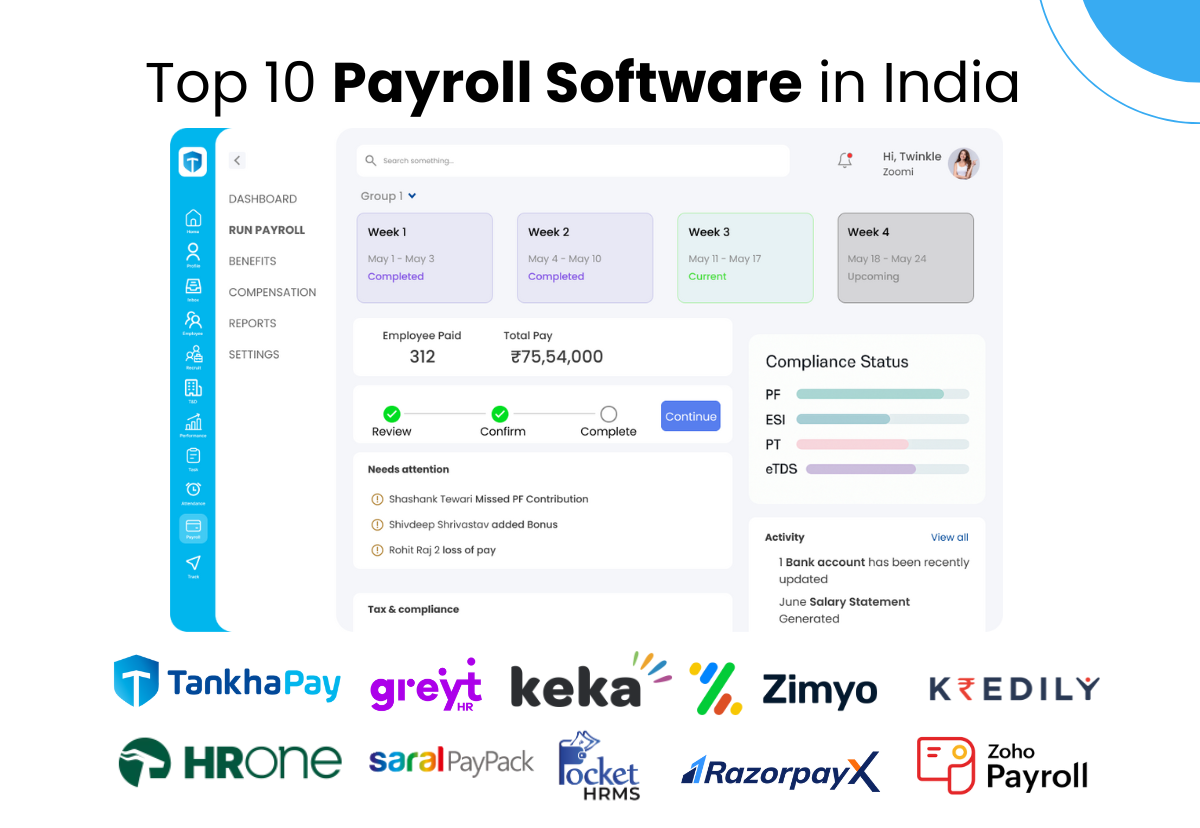
In the bustling ecosystem of Indian startups and small businesses, where innovation drives growth but resources are often stretched thin, managing payroll can feel like a relentless administrative burden. As of October 2025, with India’s workforce exceeding 500 million and evolving labor laws demanding stricter compliance, manual payroll processes are no longer viable. Enter payroll software in India—a game-changer that automates salary calculations, tax deductions, and statutory filings, freeing up founders and HR teams to focus on scaling their ventures.
This comprehensive guide dives deep into the best payroll software in India tailored for small businesses (under 50 employees) and startups. We’ll explore why these tools are essential, key features to prioritize, and detailed reviews of the top contenders based on recent user feedback, pricing, and capabilities. Whether you’re bootstrapping a tech startup in Bengaluru or running a boutique consultancy in Mumbai, the right payroll software can slash processing time by up to 80%, reduce errors, and ensure you’re always audit-ready. By the end, you’ll have the insights to choose a solution that aligns with your budget and growth trajectory.
Why Payroll Software in India is a Must for Small Businesses and Startups
India’s payroll landscape is uniquely complex. Businesses must navigate federal regulations like the Employees’ Provident Fund (EPF), Employee State Insurance (ESI), Tax Deducted at Source (TDS), and state-specific Professional Tax (PT), alongside annual changes in income tax slabs and labor codes. For startups, where cash flow is king and teams are lean, errors in payroll can lead to penalties up to ₹10,000 per violation or erode employee trust—critical when retention costs can hit 1.5x an employee’s salary.
Payroll software in India addresses these pain points by:
- Automating Calculations: Handling variable pays, bonuses, overtime, and deductions with precision.
- Ensuring Compliance: Auto-filing returns to portals like EPFO and Income Tax e-filing, with real-time updates for 2025 reforms like the new Labour Codes.
- Streamlining Operations: Integrating with attendance trackers, accounting tools, and banking for one-click disbursals.
- Enhancing Employee Experience: Self-service portals for payslip access, leave requests, and tax declarations, boosting satisfaction in remote/hybrid setups.
According to a 2025 Clutch survey, 62% of Indian SMEs using cloud-based payroll software reported 40% faster month-end closes and 25% lower compliance risks. For startups, the ROI is even clearer: tools starting at ₹0/month mean you can onboard without upfront costs, scaling as you hire.
But not all software fits every business. Small teams need intuitive, affordable options with mobile access, while growing startups prioritize integrations and analytics. Let’s break down the must-have features before spotlighting the best picks.
Key Features to Look for in Payroll Software in India
When evaluating payroll software in India, focus on these core elements to ensure it scales with your business:
- Statutory Compliance Automation: Seamless handling of PF (up to 12% employer contribution), ESI (for salaries under ₹21,000), TDS (slab-based from ₹2.5 lakh exemption), and PT (varies by state, e.g., ₹200-2,500 annually). Look for auto-reminders and e-filing integrations.
- Salary Structure Flexibility: Support for CTC breakdowns, HRA exemptions (up to 50% in metros), LTA, and custom components like ESOPs or performance bonuses—vital for startups offering equity perks.
- Integrations: Sync with tools like Zoho Books, QuickBooks, Tally, Google Workspace, or Slack. For startups, API access for custom fintech ties (e.g., Razorpay payouts) is a bonus.
- Employee Self-Service (ESS): Portals for viewing payslips, Form 16, leave balances, and investment proofs. Mobile apps are non-negotiable in 2025’s gig economy.
- Reporting & Analytics: Dashboards for cost forecasts, attrition trends, and tax projections. Advanced users want AI-driven insights, like salary benchmarking.
- Security & Scalability: GDPR/CCPA-compliant data encryption, role-based access, and plans that grow from 10 to 500+ employees without migration hassles.
- Support & Pricing: 24/7 chat/email in India, free trials (14-30 days), and per-employee/month models (₹25-₹100) over flat fees.
Pricing typically ranges from free tiers for basics to ₹50-₹200/employee/month for premium features. Avoid hidden costs like setup fees (₹5,000+) or per-filing charges. Now, let’s compare the top 8 payroll software in India for small businesses and startups, selected from 2025 reviews on G2, Capterra, and SoftwareSuggest.
| Software | Best For | Starting Price (per employee/month) | Key Features | G2 Rating (2025) | Limitations |
|---|---|---|---|---|---|
| Kredily | Bootstrapped Startups | ₹0 (Free Forever) | Core payroll, HR basics, compliance | 4.7/5 | Limited advanced analytics |
| RazorpayX Payroll | Fintech-Savvy Teams | ₹100 | 3-click payouts, auto TDS/PF | 4.3/5 | Basic HR modules |
| Zoho Payroll | Zoho Ecosystem Users | ₹50 (Free for <10) | Integrations, ESS portal | 4.4/5 | Steeper learning for non-Zoho users |
| Keka | Growing SMBs | ₹99 | Performance mgmt, mobile app | 4.6/5 | Custom pricing for >50 employees |
| GreytHR | Compliance-Focused | ₹1495/month (flat for small) | 100+ reports, Middle East support | 4.5/5 | Interface feels dated |
| SumHR | Simple Onboarding | ₹80 | Attendance sync, self-service | 4.2/5 | Slower for large batches |
| Pocket HRMS | AI-Driven Insights | ₹60 | Vernacular payslips, AI forecasts | 4.5/5 | Higher setup time |
| Craze | All-in-One Startups | ₹60 | Onboarding automation, unlimited policies | 4.4/5 | No mobile app yet |
(Data compiled from G2, Capterra, and vendor sites as of Oct 2025)
Detailed Reviews of Top Payroll Software in India
1. Kredily: The Free Powerhouse for Bootstrapped Startups
Kredily tops our list for its “Free Forever” plan, ideal for startups under 20 employees juggling limited budgets. Launched as a comprehensive HR-payroll suite, it handles salary slips, TDS filings, and PF/ESI in under 10 minutes. Users rave about its simplicity: “As a bootstrapped AI startup, Kredily’s zero-cost entry gave us transparency without spreadsheets,” says a Bengaluru founder.
Pros:
- Unlimited components for custom CTC (e.g., ESOP tracking).
- Mobile app for ESS and geo-fenced attendance.
- Integrates with Razorpay for instant bank transfers.
Cons:
- Premium analytics (e.g., attrition heatmaps) start at ₹49/employee.
- Best for India-only; limited global payroll.
Pricing: Free (core); ₹49-₹99 for pro features. 14-day trial on paid plans. Who It’s For: Early-stage startups prioritizing cost over bells and whistles. With 20,000+ users in 2025, it’s a safe bet for compliance without complexity.
2. RazorpayX Payroll: Automation at Fintech Speed
RazorpayX, from the ₹10,000 crore fintech giant, is the go-to for startups embedded in digital payments. Its “3-click payroll” executes disbursals to any Indian bank, auto-handling TDS, PT, and compliances via API ties to EPFO. A 2025 review notes, “Switched from Excel—now payroll is as seamless as our UPI flows.”
Pros:
- Embedded finance: Bulk payouts with zero failed transactions.
- Compliance dashboard with audit trails.
- Free 3-month pro trial.
Cons:
- HR modules (e.g., performance) require add-ons.
- Geared toward urban startups; rural PT nuances need manual tweaks.
Pricing: ₹100/employee (includes payouts); custom for enterprises. Who It’s For: E-commerce or SaaS startups needing payment-payroll synergy. G2 users score it 4.3/5 for speed.
3. Zoho Payroll: Seamless for Ecosystem Loyalists
Zoho’s cloud-native tool shines in integrations, syncing natively with Zoho Books, CRM, and People for end-to-end ops. It automates HRA exemptions and Form 16 generation, with a free tier for micro-teams. “Breeze for our 15-person agency—tax calcs are spot-on,” per a Capterra review.
Pros:
- Multi-language payslips (Hindi, Tamil).
- AI tax optimizer for employee declarations.
- Robust mobile app for approvals.
Cons:
- Non-Zoho integrations via Zapier only.
- Free plan caps at 10 employees.
Pricing: Free (<10); ₹50-₹200/employee. 14-day trial. Who It’s For: Startups already in the Zoho stack. 4.4/5 on G2 from 18+ reviews.
4. Keka: The Employee-Centric All-Rounder
Keka blends payroll with performance mgmt, making it perfect for startups fostering culture. Its formula engine customizes salary structures (e.g., flexi-benefits), and ESS portal cuts HR queries by 50%. “Transformed our remote team’s payday experience,” says a Delhi startup CEO.
Pros:
- 360° feedback integration for bonus calcs.
- WhatsApp/SMS payslips.
- Scalable to 1,000+ users.
Cons:
- Onboarding takes 1-2 weeks.
- Pricing jumps for add-ons.
Pricing: ₹99/employee (essentials); custom pro. 30-day trial. Who It’s For: Growth-stage SMBs valuing engagement. 4.6/5 G2 rating.
5. GreytHR: The Compliance Veteran
With 20+ years, GreytHR is the reliable choice for risk-averse small businesses. It offers 100+ reports and Middle East expansions for global startups. Users appreciate its “set-it-and-forget-it” filings: “No more EPFO headaches.”
Pros:
- Unlimited custom workflows.
- Biometric attendance sync.
- Strong audit support.
Cons:
- UI lags behind modern rivals.
- Flat pricing less flexible for tiny teams.
Pricing: ₹1,495/month (up to 50); scales up. Who It’s For: Traditional SMEs in manufacturing/services. 4.5/5 on G2.
6. SumHR: Simple and Speedy for Newbies
SumHR targets startups ditching spreadsheets, with quick setup (under 24 hours) and unlimited components. Its self-service focus empowers non-HR founders. “Payslips in seconds—game-changer for our 12-person team,” per SoftwareSuggest.
Pros:
- Formula-based deductions.
- Expense reimbursements built-in.
- Affordable for solos/duos.
Cons:
- Report generation slows >100 employees.
- Limited third-party apps.
Pricing: ₹80/employee. Free demo. Who It’s For: First-time users in creative industries. 4.2/5 rating.
7. Pocket HRMS: AI-Powered for Insights
Pocket HRMS leverages AI for payroll forecasts and vernacular support, ideal for diverse Indian teams. It won “Best HRMS 2021” and continues strong in 2025. “AI saved us from overstaffing pitfalls,” notes a Hyderabad review.
Pros:
- Predictive analytics for budgets.
- Multi-company management.
- Regional tax handling.
Cons:
- Setup requires training.
- Premium AI at extra cost.
Pricing: ₹60/employee. Custom quotes. Who It’s For: Data-driven startups. 4.5/5 G2.
8. Craze: The Modern All-in-One
Craze (YC S22) automates onboarding to payouts, with unlimited policies for agile startups. “From hire to pay in days—perfect for our scaling op,” says a user.
Pros:
- Real-time sync across HR/IT.
- No limits on storage/structures.
- Approval workflows.
Cons:
- Mobile app in beta.
- Best for <50 users.
Pricing: ₹60/user. Variable add-ons. Who It’s For: Fast-growing tech teams. 4.4/5 on reviews.
How to Choose the Right Payroll Software in India for Your Business
Selecting payroll software in India boils down to your stage: Free tiers like Kredily for ideation phase; RazorpayX for funding rounds with payouts. Assess via:
- Demo & Trial: Test 2-3 options for your exact salary structure.
- User Reviews: Check G2/Capterra for India-specific feedback (e.g., monsoon leave handling).
- Total Cost: Factor support/training (₹2,000-₹5,000 one-time).
- Future-Proofing: Ensure API scalability for 2x growth.
In 2025, hybrid work and gig laws amplify the need for mobile-first tools. Consult a CA for custom fits.
Implementation Best Practices
- Data Migration: Export Excel to CSV; most tools offer wizards.
- Training: 2-4 hours for teams; use vendor webinars.
- Go-Live: Pilot with one cycle, then full rollout.
- Monitor: Track KPIs like error rates (<1%) post-launch.
Common pitfalls: Ignoring state PT variances or skipping employee training—leading to 20% adoption dips.
Conclusion: Empower Your Growth with Smart Payroll
In India’s dynamic startup scene, payroll software isn’t just admin—it’s a strategic enabler. Kredily leads for affordability, RazorpayX for speed, and Zoho for ecosystems, but the best choice mirrors your priorities. Invest now to cut costs by 30% and comply effortlessly, positioning your business for unicorn potential.