
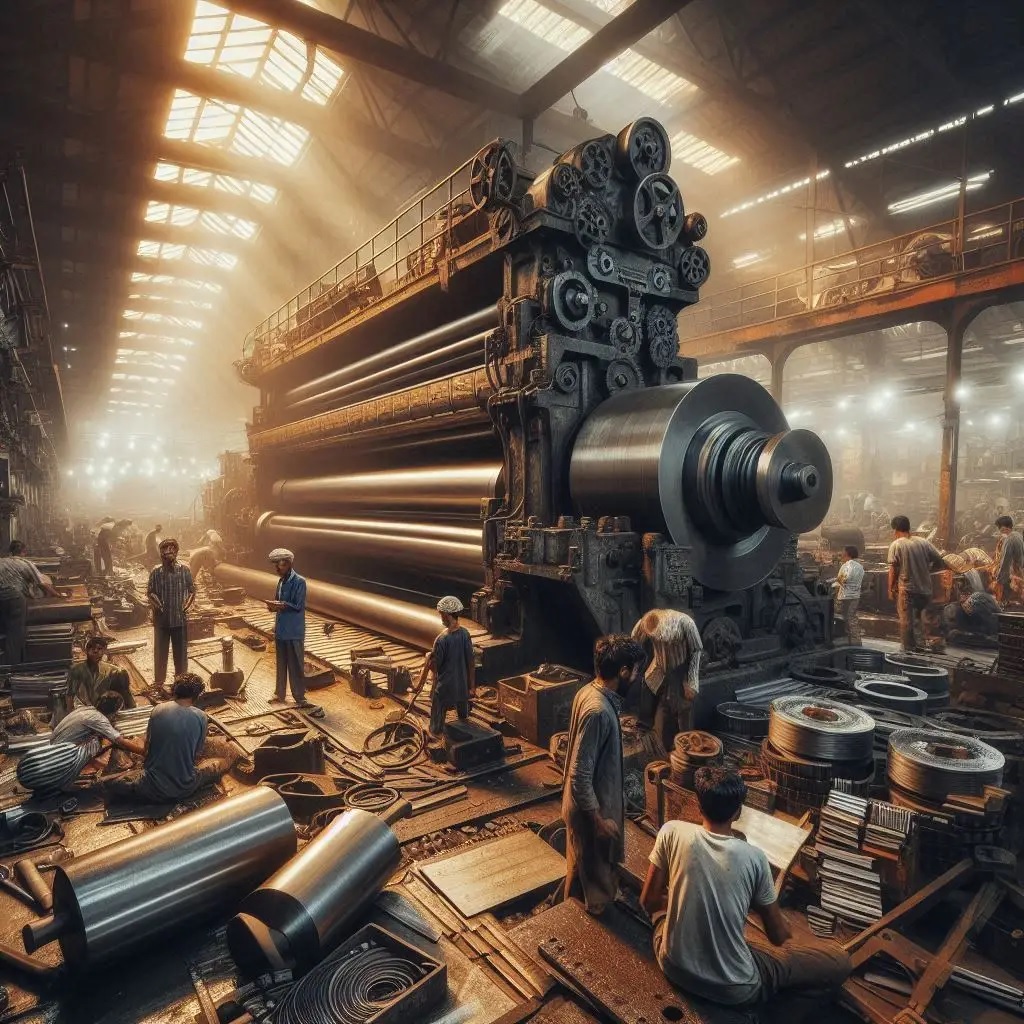
The metal rolling machine has fundamental components including rolls, which are the main working parts that will form the metal sheets or plates under pressure. The main frame provides stability and supports the entire rolling machine to maintain accuracy, precision, and durability. The drive systems are powered using an electric motor or hydraulics to control the speed and rotation of the rolls. Screw-down or hydraulic adjustments provide modification of the gap in between rolls for thickness.
Control panels with PLC or CNC systems allow the operator to ensure accurate and repeatable processes. Additional parts, such as Safety guards, lubrication systems, and feeding mechanisms maintain operational efficiency, reliability and safety for the operator.
Working principle of Metal rolling machine
The operational principle of a metal rolling machine revolves around the plastic deformation of metal as it passes between two or more rolls that are turning. When a metal sheet or plate is introduced into the machine, the rolls create a compressive force that reduces its thickness while increasing its length. The rolls are covered to turn continuously in opposite directions so that they pull the material through the rolls, providing a uniform pressure to obtain the target curvature or flatness. Machines are designated as plate rolling, sheet rolling, or section rolling depending on the configuration of the rolls. The rolls can be two, three, or four based on the type of machine to perform initial bending and final shaping. More advanced machines will utilize hydraulic or CNC controls to adjust roll locations precisely to ensure a repeatable outcome with high dimensional accuracy.
How is Metal rolling machine manufactured in India?
In India, metal rolling machinery involves a mix of sophisticated engineering design, precision machining, and solid fabrication. The process starts with design and simulations based on CAD/CAM to satisfy the required dimensions and performance standards. The manufacturers use high-quality steel and alloys to create the machine frame and rolls and machine those materials with advanced CNC equipment to achieve better tolerances and surface finishes. Hydraulic and other systems such as reliability-based motors, gear boxes, and control panels will be procured from known suppliers. Into assembly, the total mechanical and electrical systems are brought together, and the machinery will go through inspections, load tests, and calibrations before shipping to fit required damage specifications. Many Indian manufacturers also use some level of CNC or PLC automation for increased precision, productivity, and ease of operation, making their machines competitive in domestic and international markets.
Applications and uses of Metal rolling machine
Metal rolling machine India are widely used in industries to shape and form sheets, plates, and sections of metal. They have become a crucial part of fabricating pressure vessels, storage tanks, boilers, and pipelines where curvature and thickness must be controlled to precise tolerances. Rolling machines are also utilized in the production of automotive and aerospace body panels, structural components, and frame construction.
The construction and infrastructure industry also uses rolling machines for the manufacture of beams, columns, and curved metal sections for bridges and buildings. Rolling machines are also used in shipbuilding, heavy machinery, and energy equipment manufacturing applications for bending large metal plates in a very precise and accurate way. The versatility of rolling machines enables them to be used by both small workshops and in mass production with high efficiency.