
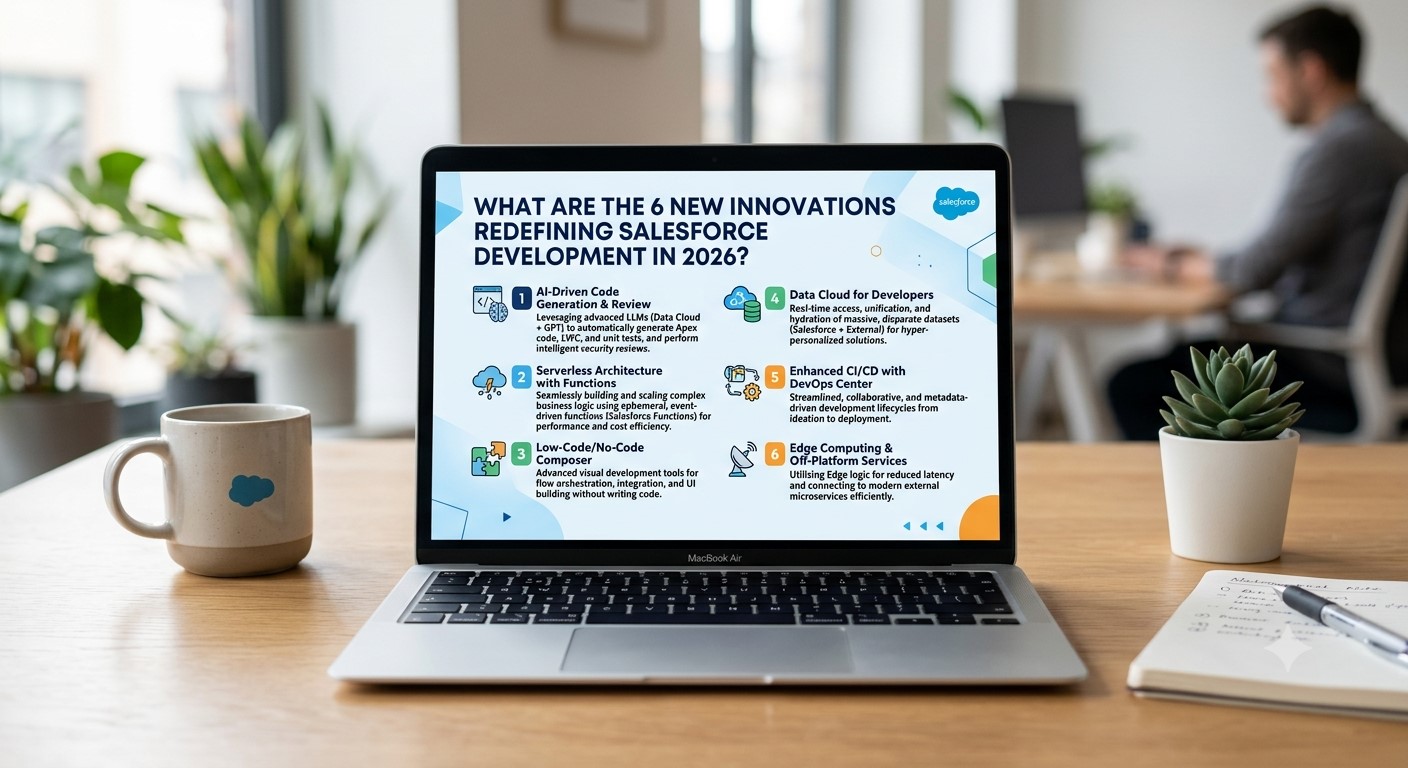
In the last two years, the working system of Salesforce has changed a lot due to the launch of new tools. After the TDX 2026 and the Summer 26 release, these new tools are helping Salesforce developers actually get their things done.
Through this article, we have tried to make you explain these new innovations that redefine Salesforce Development in 2026. Taking the Salesforce Course Online can help you learn about this. Also, this can help you become a Salesforce developer. So let’s begin discussing this in detail:
6 New Innovations Redefining Salesforce Development in 2026
1. Agentforce Vibes
This one turns VS Code into more of an idea-first workspace instead of just a code editor. It runs on a shared catalog teams can reuse across projects, plus a bunch of ready-made skills and live React previews that show changes the moment they happen. On top of that, it plugs straight into the Anthropic Agent SDK and Open AI Codex from inside the editor, with plans for several AI agents working side by side to build bigger Salesforce apps together. For developers, that means a lot less back-and-forth eating up build time.
2. Agent Script
Some workflows can’t just run on a model’s best guess, especially when the order of steps actually matters. Agent Script lets builders lock in exact if/then steps for situations where sequence and outcome have to be guaranteed – like checking someone’s identity before ever sharing account details. It looks small on paper, but it fixes a real trust problem that agent-based tools kept running into. Salesforce
3. Salesforce Multi-framework
Developers used to have to choose one side: stay fully Salesforce-native, or bring in outside frameworks and lose some platform perks. Multi-framework support gets rid of that choice, letting teams build native apps starting with React while keeping Salesforce’s built-in login security, protection, and control in place. It’s a real win for teams that wanted React’s flexibility without giving up what the platform already protects. Salesforce
4. Headless 360
Salesforce used to be something you opened in a browser tab and nothing more. That’s changing. Headless 360 opens up the whole platform through APIs and command-line tools, so agents can read, write, and act across the CRM from wherever people already work – Slack, Chat GPT, or anywhere else. This matters a lot more now that agents are starting to handle daily CRM tasks instead of people clicking through screens. Salesforce
5. Multi-Agent Orchestration
Instead of building one agent to handle a whole process alone, this feature lets several agents team up and work together on complex workflows, which fits the bigger Summer ’26 push toward multi-agent setups, Slack-based work, and real-time data. Salesforce
6. Tableau MCP
An AI model is only as good as the data feeding it, and this is where a lot of enterprise AI falls short. Tableau MCP connects AI agents straight into Tableau’s analytics engine, so answers come from real business data while staying protected by Salesforce’s trust layer. For anyone building data-heavy tools, this closes a gap that used to take a lot of custom setup to fix.
What This Means If You Want a Career Here
None of these tools run on their own – someone still has to understand the platform, write the code, set up the agents, and keep it all secure. That’s why trained Salesforce professionals are still in high demand, even as the tools get smarter.
If you’re just starting, a good Salesforce Course Online is often the easiest way in, since you can learn Agentforce, Apex, and the newer AI tools at your own pace, from anywhere.
Why Take Training in Noida?
If you learn better in person, a solid Salesforce Institute in Noida puts you close to the same IT and consulting companies already using these tools for real client work, which makes the learning feel a lot less like theory.
Why Apply for Training in Pune?
For students who are living in Maharashtra, taking Salesforce Classes in Pune are worth a look too, since plenty of IT and product companies there are already using Agentforce and these newer features in live projects.
Conclusion:
From the above discussion, it can be said that Salesforce Development is moving fast in 2026, but what still decides who gets ahead has not changed a lot. All you need is solid training, real practice, and staying current with each release. Then why wait long? Apply to the course today.