
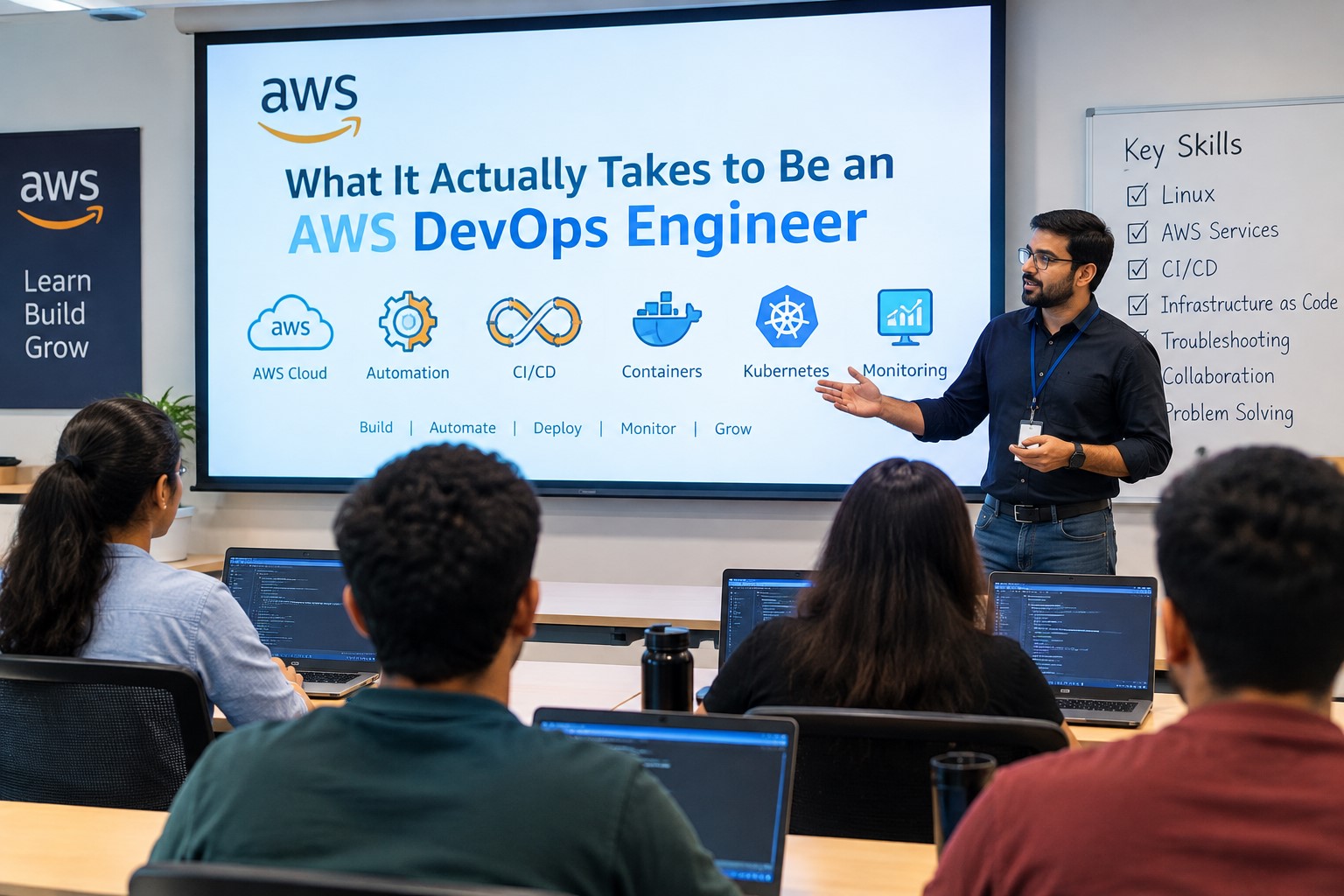
The meaning of the word DevOps” was limited, and based on this, companies had no idea what they were looking for. But this has changed completely. Because if a company is running anything on AWS, then they may need someone who can actually own the pipeline. This includes everything from code commit to production without failing anywhere.
In this article, we have discussed in detail that this may need to be an AWS DevOps Engineer. If you are looking to become an AWS Certified DevOps Engineer Professional, then learning these skills can help you get several opportunities. So, let’s begin discussing this in detail:
Start with the certification question.
There are many people who are confused about whether taking a course for AWS Certified DevOps Professional is worth it or not. So it is not easy, and it is one of the more complex exams, and it is not about testing whether you remember service names. This gives you scenario-based questions where you have to find out what is wrong in a deployment or how you can automate a real-world setup. If you pass this, most hiring managers will take this seriously.
Infrastructure as code isn’t optional anymore.
Nobody’s manually spinning up EC2 instances through the console at any real company. You need to be comfortable writing CloudFormation templates or Terraform configs, and honestly, Terraform has become the more common ask in job listings even outside pure-AWS shops, since it works across cloud providers.
CI/CD is where you’ll spend most of your actual working time.
It means understanding CodePipeline, CodeBuild, and CodeDeploy if you are using AWS-native. But most of the teams are integrated with Jenkins or GitHub Actions too. So the skill will not be just limited to knowing and understanding the tools, but also having an idea of how to design a pipeline that catches bugs early without slowing developers down so much they start working around it.
Containers, basically everywhere.
Docker is assumed knowledge at this point. Kubernetes, especially through EKS, comes up constantly in job descriptions, though smaller teams sometimes lean on ECS or Fargate instead since they’re less operationally heavy. Worth learning both if you can.
Monitoring matters more than people think when they’re starting out.
Modern engineers often treat CloudWatch as an afterthought. But this should not be, and being able to set the alerts that can catch the problem before a customer notice is genuinely one of the most valuable skills ever. Also, it is underrated compared to things like Kubernetes.
Security has to be baked in, not tracked on at the end.
IAM permissions, encryption, AWS Config for compliance- this stuff used to be a separate team’s job. Now it’s expected that DevOps engineers understand it well enough to build it into the pipeline itself. People call this DevSecOps, though honestly, it’s just… doing DevOps properly.
You’ll need to script, even if you’re not a “real” programmer.
Python and Bash cover most of what comes up day to day. Ansible is common for configuration management. You don’t need to be able to build an app from scratch, but you do need to be comfortable enough with code that automation doesn’t feel intimidating.
Cost is quietly part of the job too, even if nobody puts it in the job description.
Well, it’s quite easy to change the resources while testing and just forget about this and this is usually how a company ends up with the bill at the end of the month. So, the engineers who actually notice this are the ones who can set up the budget alerts, clean up the unused resources, and think about whether something really needs to run full time or could be scaled down overnight. This is how tools such as AWS Cost Explorer and Trusted Advisor help, but most of this just comes down to paying attention instead of predicting, someone else who watches the bill.
On training and courses
Self-teaching works, up to a point. But many people fall into trouble when they come to know about the individual tools but won’t be able to see how they fit together into an actual working system. This is usually where the AWS DevOps Course can help you learn. It is less about learning the new facts, more about seeing the pieces connect in a lab environment instead of a scattered collection of YouTube videos.
Broader DevOps Training, the kind that covers Git properly, Agile workflows, and how teams actually collaborate, fills in gaps that AWS-specific courses sometimes skip. DevOps was never really just about tools. It’s about how a team ships software without stepping on each other.
Why Hyderabad Specifically
If you’re based in India, you’ve probably noticed how much AWS DevOps Training in Hyderabad has grown as a search term and as an actual industry. It’s not random; a lot of global companies have set up delivery centers there, and they’re hiring locally for cloud roles constantly. Training providers in the city have adjusted accordingly, often running evening or weekend batches aimed at people already working full-time and trying to make the jump into cloud roles without quitting their current job first.
Conclusion:
Being good at the technical side gets you in the door, but the engineers who really do well are the ones who can sit in a room with developers who want to ship fast and ops folks who want nothing to break, and actually get both sides to agree on something. That’s not a technical skill you can put on a resume, but it’s the difference between someone who’s fine at this job and someone who’s genuinely good at it.