
Introduction:
The world of software development inside SAP has changed tremendously, as organizations migrate from traditional SAP ECC systems to current SAP S/4HANA. In previous systems, developers mostly developed procedural ABAP code utilizing standard reports, function modules, and include programs. But S/4HANA needs a clean, modular, scalable, and maintainable software architecture. This is where Object Oriented ABAP (OO ABAP) comes into play. OO ABAP enables developers to construct enterprise applications based on today’s programming concepts like classes, interfaces, and inheritance. If you are a working professional in SAP, then learning these changes is a must to stay competent for the job. With the help of SAP S4 HANA Course update your skills and maintain consistency. In this post, we will discuss what Object-Oriented ABAP is, its basic pillars, and how to implement it effectively in SAP S/4HANA projects.
What is Object-Oriented ABAP in SAP S/4HANA?
Object-Oriented ABAP (OO ABAP) is an extension of the existing ABAP programming language that brings object-oriented programming (OOP) ideas to SAP development.
SAP S/4HANA OO ABAP is no longer an option – it is the default requirement. Today, S/4HANA frameworks such as ABAP RESTful Application Programming Model (RAP) and Core Data Services (CDS) Views are constructed from Classes and interfaces. In ABAP, the code is split into separate parts, called Classes and Objects. S/4HANA frameworks separate business logic from database activity and, from back‑end user interfaces.
Businesses only prefer candidates with credentials. Therefore, to work in this, you need to obtain SAP S4 HANA Certification and become eligible for the job.
The Basic Pillars of Object-Oriented ABAP in SAP:
OO ABAP is based on four basic elements that enable you to structure clean corporate code:
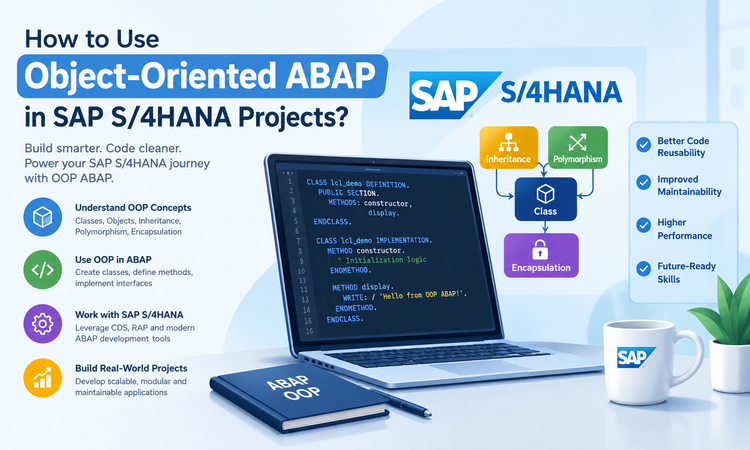
Encapsulation: Hides the data processing details of a class by using visibility sections called PUBLIC, PROTECTED, and PRIVATE. This stops programs from changing internal data directly.
Inheritance: Allows a child class to take methods and attributes from a parent class. This reduces duplicate code. Speeds up adding new features.
Polymorphism: It means different classes can have the same method names, but each class can do it in its own way. Polymorphism makes the reasoning of software more flexible and easier to alter.
Abstraction: Interfaces define what a class should do. Not how it does it. This creates design rules that everyone on the team can follow.
Learn in detail about these components in ABAP by enrolling in SAP ABAP on HANA Training.
Steps to Use Object-Oriented ABAP in SAP S/4HANA Projects:
To adopt ABAP successfully in your SAP S/4HANA implementation or upgrade project, follow these practical steps:
Step 1: Switch to ABAP Development Tools in Eclipse
Leave the transaction SE80 in the SAP GUI. Begin using ABAP Development Tools in Eclipse. Eclipse offers tools for OO ABAP, including refactoring shortcuts, syntax highlighting, static code checks, and smooth integration with CDS views.
Step 2: Define Clear Interfaces First
Before you start writing the logic for your classes, you should design the interfaces. Use tools like transaction SE24 or Eclipse for this. Interfaces set the way that your methods look (for example, calculate_tax, post_document). This helps make sure that the code is consistent across parts of the project.
Step 3: Create Modular Business Classes
Put code into classes that have one purpose. For example, make a class that only gets sales order data and another class that only does invoice calculations. Do not make classes that try to do everything.
Step 4: Replace Legacy Function Modules and Subroutines
Don’t make function modules or PERFORM subroutines. Instead, put your custom business logic inside class methods. Use methods for simple utility functions. For business objects, use instance methods. This keeps your code cleaner. Easier to manage.
Step 5: Use ABAP RAP (RESTful Application Programming)
SAP S/4HANA uses the ABAP RAP framework. Build business object definitions with CDS views. Then handle actions like create, update, and delete inside OO ABAP behavior handler classes.
Step 6: Create ABAP unit tests that are automatically executed
Use ABAP Unit Tests in your classroom. OO ABAP allows you to isolate code dependencies, enabling you to design test methods that check your business logic each time you modify code or upgrade the system.
Best Practices for SAP S/4HANA OO ABAP:
|
Follow Clean Code Guidelines |
Use names and method names that make sense. Keep each method small and focused on doing one thing. |
|
Enforce Strict Visibility |
By default, keep attributes. Only make them accessible through getter and setter methods. |
|
Avoid Direct Database Calls in Classes |
Get data using CDS Views. Then pass the datasets into your object-oriented classes for processing. |
If you want to enhance your skills in SAP while working, then join the SAP S4 HANA Online Training Hyderabad and become competent.
Sum Up:
The new SAP S/4HANA software is developed on top of object-oriented ABAP. Clean OOP concepts like encapsulation, inheritance, interfaces, unit testing, etc. along with ditching old procedural scripts will help developers to create strong and adaptive business programs. When you use ABAP RAP, Eclipse ADT, and CDS Views with OO ABAP, your code will stay scalable, easy to manage, and ready to move to the cloud in the future. OO ABAP is a skill that all SAP coders need to learn if they want to write good code in the business world today.