
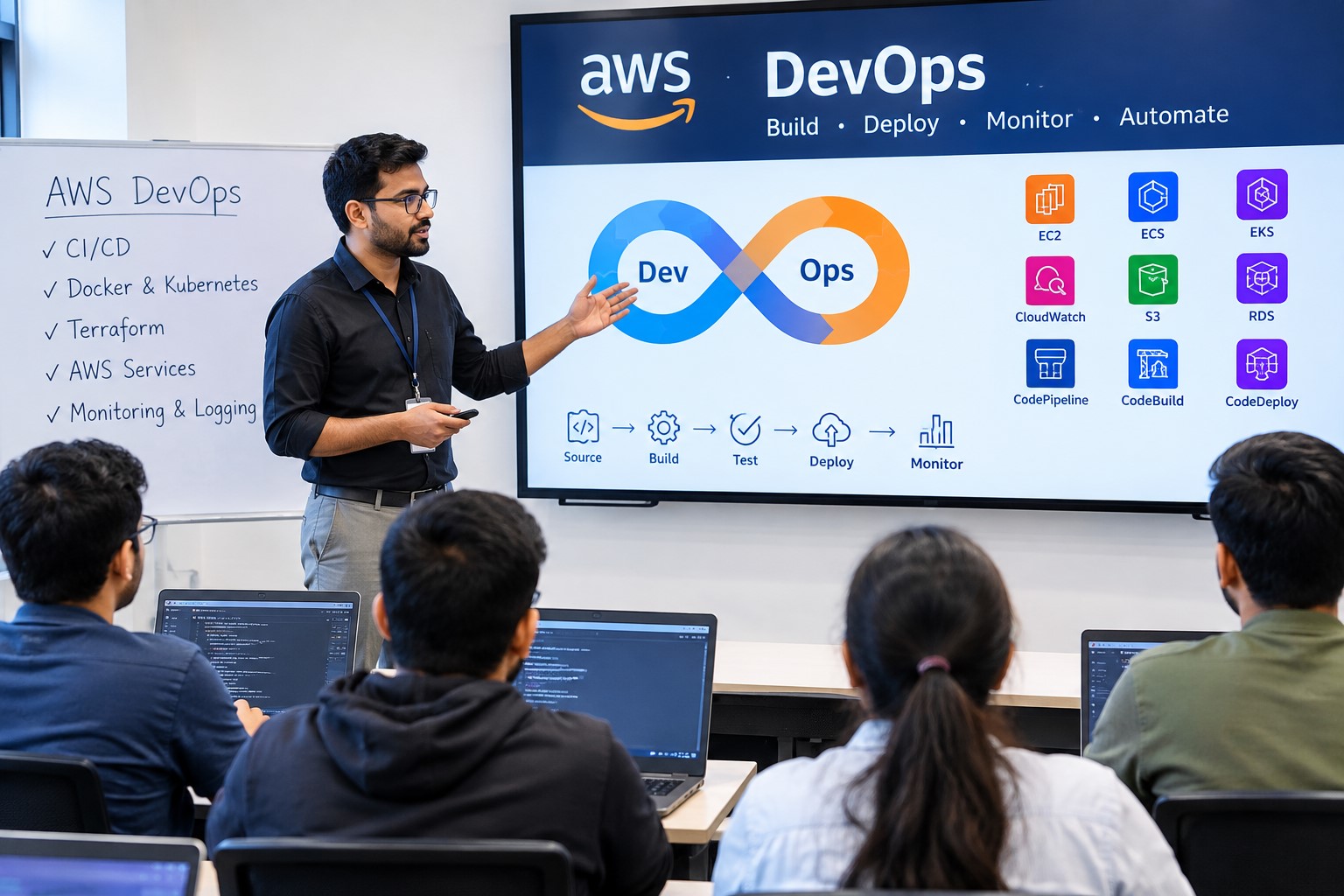
When we talk about the cloud engineering field, which AWS certification is the toughest? The AWS Certified DevOps Engineer Professional is the first one that comes. It is not something that you can prepare for the night before. This checks whether you are ready to build and run a production system on AWS. These are the pipelines that deploy everything safely, infrastructure that heals itself, and security that is enforced, not just documented.
This is why many companies are now completely dependent on automation. So this certification has become a signal to employers that someone can trust with a live environment. If you are thinking of learning this, then you need to understand the actual process for this. So let’s begin discussing this in detail:
What the Certification Actually Checks
The current version of the exam is DOP-C02. At its core, it’s asking one thing: can you own the full delivery lifecycle on AWS, start to finish? That covers setting up continuous delivery pipelines, automating security and compliance checks, building monitoring and logging, and designing systems that stay available and recover on their own. It’s less about knowing what a service is called, and more about knowing how to connect several of them together to fix a real problem – the kind you’d deal with during an actual incident, not a quiz question.
Do You Need Experience First?
Officially, no. AWS doesn’t force any prerequisite on you. But in practice, yes, you need real experience going in. AWS itself recommends having at least one Associate-level certification under your belt – Developer Associate or SysOps Administrator – plus around two years of hands-on work managing AWS environments. This isn’t AWS being overly cautious. The questions are scenario-based. If you’ve never actually built a CI/CD pipeline or fixed a broken Auto Scaling group in a real environment, the questions will feel strange no matter how much theory you’ve read.
What to Expect on Exam Day
The exam runs for 180 minutes and is fully proctored. Don’t expect simple “what does this service do” questions – most of them describe a situation, like a failed deployment or a security gap, and ask you to pick the best fix from a few options that all sound reasonable. The exam costs 300 USD, and if you already hold another active AWS certification, you get a discount voucher toward the fee.
The scope goes beyond just the basics too. You’ll likely see services like AWS Control Tower, CodePipeline, EC2 Image Builder, and Systems Manager show up inside real scenarios, along with the usual CI/CD, monitoring, and infrastructure-as-code topics.
What You Should Already Know
First, you will be expected to have written code in at least one programming language. Second, you should be able to build automated infrastructure yourself, not just read about it. This is not just a certification for someone who has only learned about the AWS Console. So you need to be comfortable with things such as:
– Building a CI/CD pipeline from start to finish, including testing and multi-stage deployments across dev, staging, and production, with approval steps in between
– Writing infrastructure as code, usually with CloudFormation or Terraform
– Baking security into the pipeline itself – IAM policies, compliance checks, governance – instead of adding it as an afterthought
– Designing systems that scale up on their own and recover without someone manually stepping in
How People Actually Prepare for It
Most people who pass this exam don’t just read their way through it. A mix of AWS’s own resources – Skill Builder, exam readiness training, Well-Architected Framework whitepapers – combined with real hands-on labs tends to work best. Setting up your own sandbox account and building a pipeline yourself teaches you things no practice question ever will.
That said, studying entirely on your own can be slow, especially if you’re still building up your foundational AWS experience. This is where a structured AWS DevOps course can help. A good course walks you through the same services and scenarios the exam covers, but with guided labs and a curriculum built around how things actually get used on the job – so you’re not left guessing which topics matter most.
Why take Training in Chennai?
If you are from South India, then applying for an AWS DevOps Course in Chennai can be a smart choice as well. Chennai is filled with strong and growing IT industries, and local training centers at that place also offer lab experience and work on case studies.
Is It Worth the Effort?
The numbers say yes. Certified professionals in the US see median base pay above $145,000, with total compensation often crossing $180,000 at larger companies. Remote roles have opened this pay range up to people regardless of where they’re based. Beyond the money, this certification tends to open the door to senior roles – the kind where you own the delivery pipeline instead of just following someone else’s playbook.
Conclusion:
For people who are aspiring to become an AWS Certified DevOps Engineer Professional in 2026 is more than memorizing the answers. This is completely about being able to build, secure, and run the production system on AWS without someone to guide you. So start practicing and don’t skip the associate-level basics, and think regarding the self-study with a proper DevOps Course for keeping the things focused. So whatever you path choose of Self-study or a proper AWS DevOps Course in any of the Indian Cities like Chennai- this certificate will reward you with the work that employers value.