
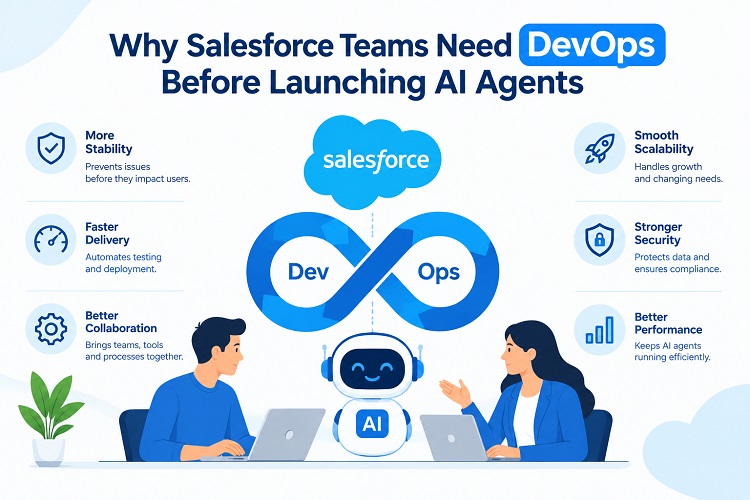
Everyone is looking for AI agents right now, and leaders have observed the demos and the pressure to launch something quickly. But many of the Salesforce teams are looking to put an agent on top of the release process, which already has to deal with the normal changes. This could be risky.
This is where the role of DevOps begins. If you are looking to become a Salesforce Developer, then taking a Salesforce course can help with the same. Also, this course will help you understand why the Salesforce team needs DevOps before launching AI agents.
Role of DevOps For Launching AI Agents:
An agent has many moving parts
People talk about Agentforce like it is one feature.It is like a platform where everything works together, such as the topics, the actions, prompt templates, flows, Apex, and the data the agent can read. When you change any of them, then the agent will behave in a different way.
Say you reword a topic. Now the agent answers a question it should have sent to a human. Or you edit the flow behind an action and it updates the wrong record. These pieces need to move from sandbox to production together, and in the right order. Doing that by hand is where mistakes happen.
Mistakes look different with AI
When a normal feature won’t work, the user will notice an error or blank field. They come to know that something is wrong and when the agent get something wrong this will write a clear and confident answer. So the customer will trust it.
An agent also does not give the same answer every time. That makes testing harder, so you need to do more of it, not less.
Sandboxes and test data
An agent is perfect till the data and actions it reaches. If the sandbox is filled of the old records, then the test will not inform you of anything. Teams that prefer to follow the DevOps refresh sandboxes on a schedule and use realistic test data. Be careful with real customer details too. Copying them is the worst idea in any project, and worse when an AI is reading them.
Questions you will get asked
Once the agent is live, someone senior will ask things like: who approved what it says about pricing? Who changed its permissions last month? Can you show me?
With a pipeline, you can. You can ask for approvals from the right people, run checks before anything goes out, and keep a record of each release. Permissions matter here because the agent can only do what its access allows, so changes to permission sets should go through the same careful route as the agent itself. For banks, insurance companies and hospitals, that record is a requirement.
When the agent gets something wrong
This may take place earlier or later. So when an agent gives a wrong answer, then someone has to fix it. The real question here is how fast you can do this without making things worse.
If your team is already using DevOps, then it will follow the usual path. Well, you have to make the changes in the branch, run the tests, and deploy them. After that, you can merge it into the other environments to get the same solution. And if a release doesn’t work properly, then you can go back to the previous one.
Why Apply in DevOps Course?
A big team is not needed for this. What helps is having people who understand both the build side and the release side. A Salesforce training is the place to start. You learn admin work, flows, Apex, and how the different parts of the platform fit. After that, a Salesforce DevOps Course teaches Git, branching, Salesforce CLI, DevOps Center, and CI/CD.
Why Apply for Agentforce Course?
Then a Salesforce Agentforce Course shows you how to design agents, write prompts, and set up topics and actions. If you learn this, you can build an agent and also release it safely. Right now, very few people can do both.
How to begin
You don’t have to sort out everything before your first agent goes live. Take small steps:
- Keep your metadata in Git, and include the agent parts
- Write automated tests for the flows and Apex behind your actions
- Make a short list of questions to test the agent with
- Add a review step before anything goes to production
- Release small changes, then read the answers the agent actually gives
Conclusion:
AI agents make releases riskier. The team that launches first may not be the one that does best. It is usually the team that can change, test and fix its agent without a panic. So get the DevOps basics in place first. Your agent will be on much steadier ground.